
Introduction
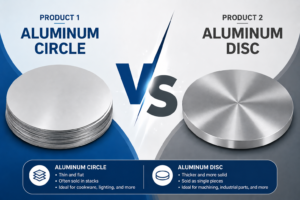
Although the terms “aluminum circle” and “aluminum disc” are often used interchangeably in the aluminum processing industry, they are commonly applied in different manufacturing environments and industrial applications.
In general:
- Aluminum circles are mainly used for deep drawing, cookware manufacturing, spinning, and lighting production.
- Aluminum discs are more commonly associated with CNC machining, structural fabrication, precision industrial components, and mechanical processing applications.
Understanding the differences between aluminum circles and aluminum discs helps buyers choose the right material for cookware production, industrial fabrication, lighting systems, electronic components, and custom processing projects.
Quick Comparison Between Aluminum Circle And Aluminum Disc
| Comparison | Aluminum Circle | Aluminum Disc |
|---|---|---|
| Main Applications | Cookware, Deep Drawing, Spinning | CNC Machining, Industrial Components |
| Production Process | Stamping / Circle Cutting | Machining / Precision Fabrication |
| Surface Requirement | Smooth Surface Finish | Flatness & Structural Stability |
| Popular Alloys | 1050 / 1060 / 1100 / 3003 | 5052 / 6061 / Industrial Grades |
| Main Industries | Cookware & Lighting | Industrial Fabrication & Machinery |
| Processing Focus | Deep Drawing Performance | Machining Precision |
| Common Temper | O / H14 | T6 / H32 |
| Surface Treatment | Anodizing, Polishing | CNC Finish, Precision Machining |
| Export Markets | Kitchenware & Consumer Products | Industrial Equipment & Engineering |
What Are Aluminum Circles?
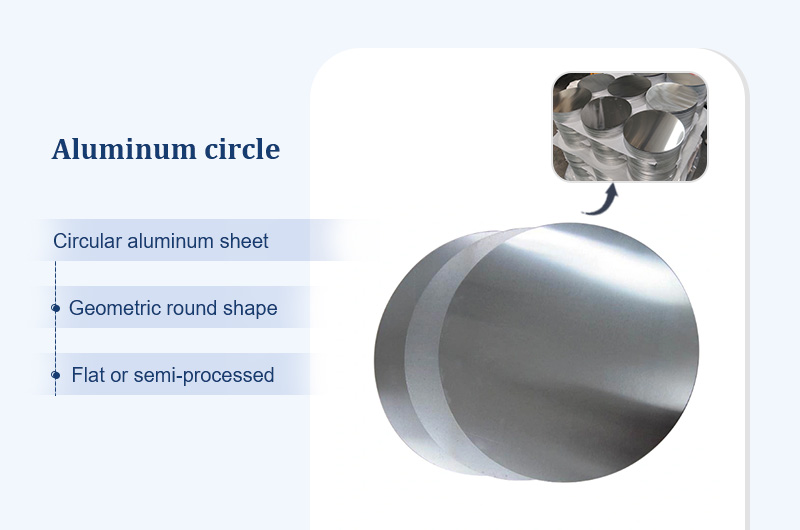
Aluminum circles are round aluminum blanks typically produced by stamping or cutting aluminum coils. They are widely used in industries requiring excellent deep drawing performance, smooth surface quality, and stable thickness tolerance.
These products are commonly manufactured from:
- 1050 aluminum circle
- 1060 aluminum circle
- 1100 aluminum circle
- 3003 aluminum circle
Because of their excellent formability and surface consistency, aluminum circles are commonly used for:
- Cookware manufacturing
- Rice cookers
- Pressure cookers
- Frying pans
- Kitchen utensils
- Lampshades
- Road signs
What Are Aluminum Discs?
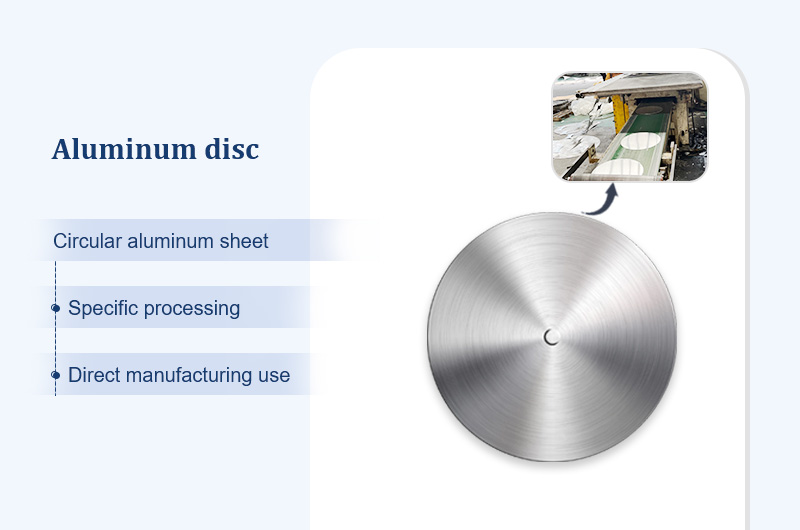
Aluminum discs are generally associated with industrial fabrication, CNC machining, and precision mechanical applications. Compared with deep drawing aluminum circles, industrial aluminum discs often require higher flatness, structural stability, and machining precision.
Popular industrial alloys include:
- 5052 aluminum disc
- 6061 aluminum disc
- 5754 aluminum disc
These materials are suitable for:
- CNC machining
- Aerospace parts
- Industrial equipment
- Mechanical structures
- Electronic housings
- Precision components
Production Process Differences
Aluminum Circle Production
Aluminum circles are commonly produced using:
- High-speed stamping
- Circle cutting
- Coil blanking
- Deep drawing grade processing
Production usually focuses on:
- Surface smoothness
- Edge quality
- Thickness consistency
- Deep drawing performance
Aluminum Disc Production
Industrial aluminum discs may involve:
- CNC machining
- Precision cutting
- Lathe processing
- Milling operations
The focus is more on:
- Structural precision
- Flatness
- Mechanical strength
- Machining tolerance
Which Aluminum Alloy Is Better?
For Cookware Manufacturing
Recommended alloys:
| Alloy | Features |
|---|---|
| 1050 | Excellent formability and thermal conductivity |
| 1060 | Good deep drawing performance |
| 1100 | Smooth surface finish |
| 3003 | Better strength and corrosion resistance |
For Industrial Machining
Recommended alloys:
| Alloy | Features |
|---|---|
| 5052 | Corrosion resistance and strength |
| 6061 | Excellent machinability |
| 5754 | Structural performance |
| 5083 | Marine and industrial applications |
Aluminum Circle vs Aluminum Disc: Which One Should You Choose?
Choose aluminum circles if your application requires:
- Deep drawing
- Spinning
- Cookware production
- Anodizing quality surface
- Lighting manufacturing
Choose aluminum discs if your application requires:
- CNC machining
- Structural fabrication
- Mechanical processing
- Aerospace components
- Industrial engineering
Conclusion
Both aluminum circles and aluminum discs are important industrial aluminum products, but their production methods, processing focus, and end-use applications are different.
For cookware, spinning, and deep drawing applications, aluminum circles are generally the preferred choice.
For industrial fabrication, precision machining, and engineering components, aluminum discs provide better structural and machining performance.
