
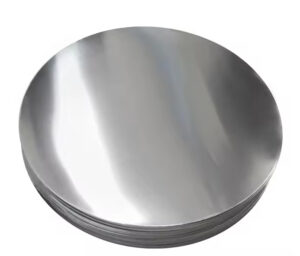
Aluminum products are widely used in industries ranging from cookware to automotive. Among them, aluminum disk blanks for industrial use have become one of the most versatile semi-finished products. If you are a manufacturer, supplier, or buyer, understanding the features, applications, and purchasing factors of blank aluminum disks is crucial.
In this guide, we will cover everything you should know about aluminum circle discs — from production processes to applications and sourcing tips.
What Are Aluminum Disk Blanks?
Aluminum disk blanks, also known as blank aluminum disks or aluminum circle discs, are flat round pieces made by cutting aluminum sheets into circular shapes. They are primarily used as raw materials for:
- Cookware manufacturing (pots, pans, kettles)
- Lighting reflectors
- Signage and nameplates
- Automotive components
- Industrial hardware
Because of their excellent formability, corrosion resistance, and lightweight nature, aluminum circle discs are considered one of the best choices for deep drawing and spinning applications.
Common Alloys for Aluminum Circle Discs
Not all aluminum is created equal. Different alloys are used depending on end applications:
- 1050 & 1060 Aluminum Disk Blanks
- High purity (99.5% aluminum)
- Excellent corrosion resistance
- Used in cookware and household utensils
- 1100 Aluminum Circle Disc
- Superior corrosion resistance
- Great for chemical equipment and architectural applications
- 3003 Aluminum Disk Blanks
- Added manganese for better strength
- Common in cookware, roofing, and siding
- 5052 & 5754 Aluminum Circles
- High strength and corrosion resistance
- Used in pressure vessels and marine applications
- 6061 Aluminum Circle Disc
- Heat-treatable alloy
- Used in automotive and aerospace parts
Manufacturing Process of Blank Aluminum Disks
The production of aluminum disk blanks involves several steps to ensure accuracy, flatness, and quality:
- Aluminum Coil Selection – The process begins with choosing the right alloy and thickness.
- Cold Rolling – Coils are rolled into the desired thickness.
- Punching/Blanking – The sheet is cut into precise circular shapes.
- Annealing (Optional) – To soften the material for deep drawing.
- Surface Treatment – Brushing, polishing, or anodizing depending on application.
This process ensures blank aluminum disks meet strict industry standards for cookware and industrial applications.
Applications of Aluminum Disk Blanks
1. Cookware & Kitchen Utensils
Perhaps the most well-known use of aluminum circle discs is in kitchenware. They are used to manufacture:
- Frying pans
- Pressure cookers
- Tea kettles
- Pizza pans
Their lightweight structure, non-toxic nature, and even heat distribution make them ideal for cookware.
2. Lighting Industry
Aluminum disk blanks are polished and anodized to create reflectors, lamp covers, and lighting fixtures.
3. Automotive Industry
High-strength aluminum circle discs are used for automotive fuel tanks, brake components, and decorative trims.
4. Signage & Decorative Items
Due to their easy machinability and ability to hold paint, blank aluminum disks are used for signs, badges, and plates.
Standard Sizes and Specifications
Below is a typical specification chart for aluminum disk blanks:
| Diameter (mm) | Thickness (mm) | Alloy Options | Common Applications |
|---|---|---|---|
| 100 – 150 | 0.4 – 1.0 | 1050, 1060 | Small cookware lids |
| 200 – 400 | 0.6 – 3.0 | 1100, 3003 | Pots, pans, kettles |
| 450 – 800 | 1.0 – 6.0 | 5052, 5754 | Industrial equipment |
| 900 – 1200 | 3.0 – 8.0 | 6061 | Automotive, aerospace |
Why Choose Aluminum Circle Discs Over Other Materials?
- Lightweight yet durable – Reduces overall product weight.
- Excellent corrosion resistance – Ideal for cookware and outdoor uses.
- Eco-friendly & recyclable – 100% recyclable without losing properties.
- High formability – Perfect for deep drawing and spinning.
- Cost-effective – More affordable than stainless steel or copper.
Buying Tips: How to Select Quality Aluminum Disk Blanks
When sourcing aluminum disk blanks for industrial use, consider these factors:
- Alloy Grade – Match the alloy with your application.
- Surface Quality – Look for smooth, defect-free surfaces.
- Tolerance & Precision – Ensure strict dimensional accuracy.
- Certifications – ISO, ASTM, or EN standards for guaranteed quality.
- Supplier Reliability – Choose established manufacturers with proven track records.
Final Thoughts
Aluminum disk blanks for industrial use are indispensable materials across cookware, automotive, lighting, and signage industries. With the right alloy selection, surface treatment, and reliable supplier, you can ensure your products meet high performance and safety standards.
Whether you need blank aluminum disks for cookware or aluminum circle discs for industrial applications, they offer the perfect balance of durability, formability, and cost efficiency.
